
Contrarian investing has a long and validated history, no less so than in the real estate environment of Cambodia. Crises compress valuations, flush out weak hands, and create entry points that benign markets rarely offer. The property market in April 2026 — battered by a domestic NPL overhang, a geopolitical energy shock, and subdued investor sentiment — may, for the patient, well-capitalised investor, represent precisely one of those rare moments. The caveat is that discipline, specificity, and a clear-eyed understanding of risk are essential. This is not a market for passive optimism. But the opportunities are real.

- Distressed real estate discounts: high-end condominiums at below-replacement cost
The luxury property market continues to underperform compared to affordable housing segments. However, this creates value opportunities for patient investors with long-term horizons who can acquire premium assets at significant discounts to replacement cost. Cambodiamarketentry Crucially, in the high-end segment, developers are prepared to concede 10–15% to secure decisive buyers. Cambodiaproperty
With construction costs now rising on the back of fuel-price inflation — making new supply more expensive to deliver — existing well-located luxury units acquired below replacement cost carry a natural medium-term appreciation argument that strengthens the longer the building freeze persists.
The window, however, is not indefinite. The government has deferred its 20% Capital Gains Tax on real estate until January 1, 2027. For investors, this creates a strategic window: throughout 2026, assets may be resold under the previous regime, preserving full profit margins without surrendering one-fifth of gains to taxation Cambodiaproperty — a time-sensitive advantage that disappears at year’s end.
- Cash-flow residential investment: older shophouses and mid-tier apartments
For investors prioritising income over capital appreciation, rental yield profile remains one of the most compelling in Asia. In Q1 2026, gross rental yields for apartments ranged from 4.9% to 9.75%, with a national average of 7.54%. Rental yields in Phnom Penh, especially for older shophouse apartments, are the second highest in Asia next to Jakarta, at above 6%. Global Property Guide
By comparison, Bangkok and Ho Chi Minh City rarely yield above 3–4% net. The dollarisation of rental income is a critical structural advantage: investors collect and remit in USD, bypassing the currency devaluation risk that would otherwise compound the stress of an oil-price shock.
Even in 2026, it is still possible to buy property for $50,000, put $20,000 worth of renovation work into it, and have it valued at above $100,000 on the secondary market. InvestAsian This value-add strategy — acquiring older, poorly maintained stock in established rental catchments, renovating efficiently, and targeting the well-documented shortfall of expat-quality housing in inner Phnom Penh — is particularly well-suited to the current environment, where new construction has slowed and replacement costs have risen.
- Infrastructure-adjacent land: Techo Airport corridor and Ring Road No. 3
The one category of property where price momentum has been consistently positive through the downturn is land in infrastructure-adjacent corridors. September 2025 marked the commercial inauguration of Techo International Airport, a Class 4F aviation hub engineered to accommodate wide-body aircraft, which has subtly redirected Phnom Penh’s expansion southward. Land and residential developments along Hun Sen Boulevard and within Kandal Province are experiencing renewed valuation momentum. Cambodiaproperty
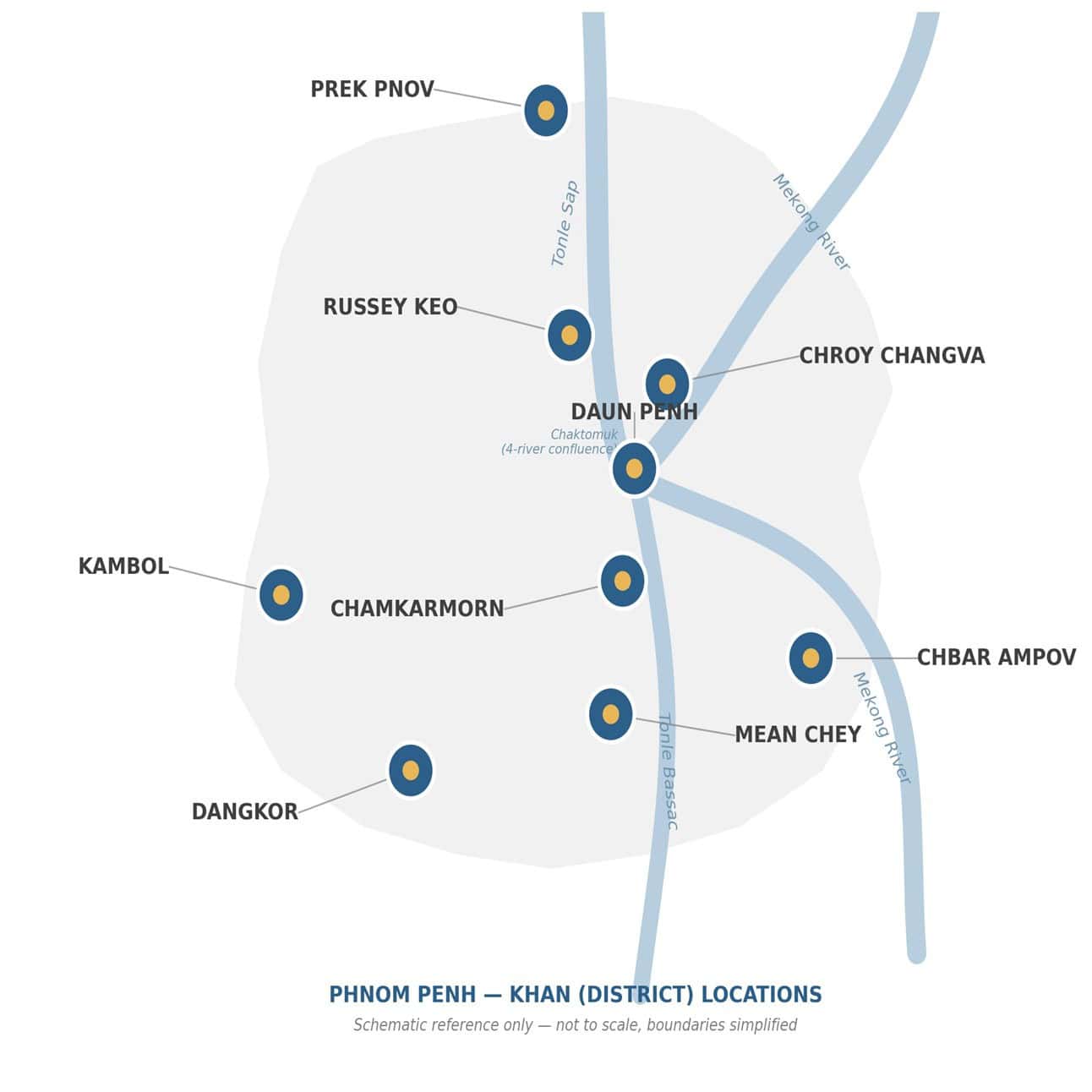
The top three areas expected to have the best price growth over the next five years are the Sen Sok to Russey Keo growth corridor in northern Phnom Penh, the Kandal province zones linked to Techo Airport, and Chbar Ampov to Meanchey in southern Phnom Penh. These top-performing areas are projected to see five-year cumulative price growth of 25% to 40%, potentially double the national average. Bamboo Routes
Ring Road No. 3 is accelerating this dynamic, turning formerly peripheral districts into accessible middle-class residential zones and compressing the price gap with central Phnom Penh. Por Sen Chey, which benefits from both airport proximity and industrial job growth in western Phnom Penh, is a specific emerging name worth monitoring at entry-level price points.
- Investment in industrial real estate and special economic zones
One category that is arguably benefiting from the geopolitical turbulence — rather than suffering from it — is industrial real estate. Global supply chain diversification away from China has been accelerating for several years, and the Iran war’s disruptions to established trade routes are intensifying that trend. CBRE notes that special economic zones are playing a pivotal role in this expansion, with several large-scale developments gaining traction in Sihanoukville and Kandal. The recently announced $297 million US-funded SEZ along the Mekong River underscores growing international interest in Cambodia’s strategic manufacturing base. Industrial property prices remain among the most competitive in the region. Cambodiainvestmentreview
For investors seeking exposure to manufacturing sector growth without direct factory investment, industrial real estate and logistics facilities offer compelling opportunities, benefiting from stable, long-term lease agreements with established manufacturers and logistics operators. Cambodiamarketentry As energy costs squeeze margins in more energy-intensive regional competitors, Labour cost advantage and its network of free trade agreements — including RCEP, and bilateral FTAs with China and South Korea — become more attractive to relocating manufacturers.
- Sentiment in Cambodia as a contrarian signal
Perhaps the most compelling investment argument of all is behavioural. One experienced observer who recently toured Phnom Penh’s market noted: “When I was meeting with local investors, bankers, and expats, everyone was negative — I like this. This is when you want to enter a market.” The Wandering Investor Analytically, the observation is sound. Cambodia’s urban population is young — median age 26 — and growing. Urbanisation is continuing. The country retains political stability following the leadership transition to Hun Manet. And the dollarised economy, while creating monetary policy constraints, offers foreign investors a currency safe harbour that most regional peers cannot match.
Essential caveats
None of this is a free lunch. Developer due diligence has never mattered more: the Prince Bank collapse has tightened scrutiny on linked entities, and several developers carry balance sheets encumbered by the same NPL pressures afflicting banks. Title verification is non-negotiable. Sihanoukville’s structural oversupply remains a trap for the undiscriminating. And the Iran ceasefire, announced April 7, remains fragile — a resumption of hostilities would reset the risk calculus across all asset classes.
ERA Cambodia’s assessment is apt: 2026 is a reset year, not a retreat year. Investors who focus on fundamentals — location, quality, management, and long-term value — will be well-positioned. ERA Cambodia In a market where fear is doing the selling, fundamentals are where the patient buyer finds their edge.
This section is intended as analytical commentary and does not constitute financial or investment advice. Readers should conduct independent due diligence and consult qualified legal and financial professionals before making investment decisions in Cambodia.